Showing posts with label exotic grains. Show all posts

Friday, November 4, 2011

Sprouted Wheat Challah with Milk & Honey

I'm pretty excited about this challah. It's a start on a venture I've been really looking forward to which is really tweaking with recipes as opposed to just doing delicious add-ins (which I love... and I have a few great ones planned for the next few weeks!).

Back in September, I made a big order from King Arthur Flour that included Sprouted Wheat Flour.  Here's what KAF says about the product:
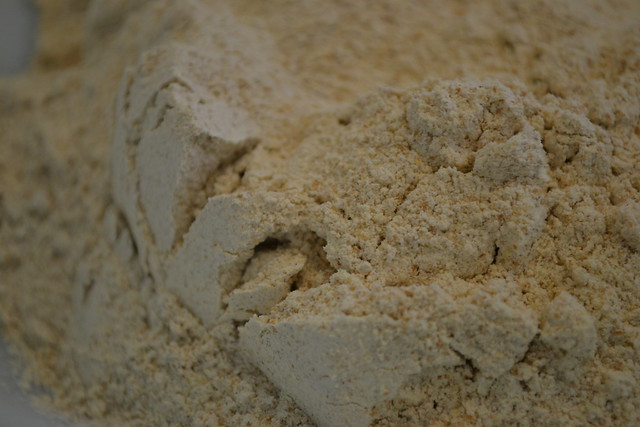
Sprouted wheat is the best way to access the grain’s nutritional benefits. As the wheat berry grows, vitamins are formed that greatly enhance the nutrition and digestibility of the wheat. Sprouted berries are dried, then ground into flour.
I was surprised that it's not actually a KAF product. The flour comes from Lindley Mills, an organic speciality flour mill located in piedmont North Carolina at the site of the 1755 water mill built by Pennsylvania Quaker and settler Thomas Lindley.
sprouted3
As I did with Spelt Challah and Kamut Challah, I wanted to do my homework about this grain before I really got going with the baking. I knew (because I read it on the label) that sprouted wheat is high in protein but what else? The more I read, the more I realized how great it is... high in B6, niacin, and lower on the glycemic index. Nice! Plus, they say it has a nice, sweet flavor. Score! I told myself. Then, I read how it can be really difficult to work with. Trying to remain unfazed, I saw a few suggestions about using milk instead of water to proof the yeast... I did a bit of experimenting and here's what I came up with...
sprouted1

3/4 c milk (I used skim because it's what I had, but other recipes suggested whole)
.6 oz fresh yeast or 2 1/2 tsp active dry yeast
1 1/2 tbsp honey plus drizzling
2 eggs plus 1 for wash
1/4 c canola oil or other neutral oil
1 1/2 c bread flour
1 1/2 c sprouted wheat flour
1 1/4 tsp salt


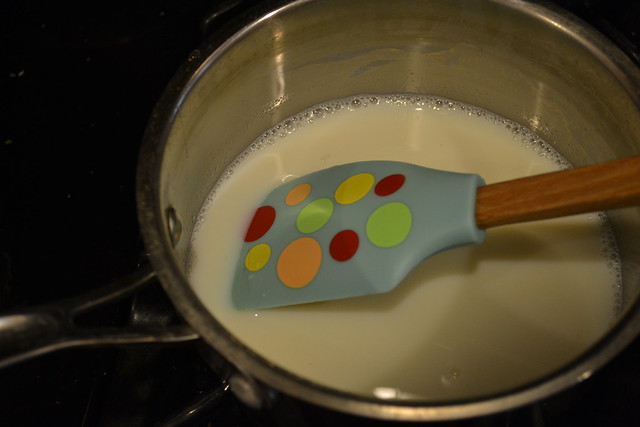
In a small sauce pan, mix together the milk and 1 1/2 tbsp honey. Warm to about 100 degrees, stirring constantly, until the the honey has dissolved. When I proof yeast in water, I just turn my hot water faucet on for a bit and use water right out of the faucet, so the 100 degree thing is really a guess... I just stick my finger in it to check if it is hot enough and that's what I did with the milk. Add the yeast, stir gently, and let rest for about 10 minutes or until foamy.

Proceed as normal. Add the eggs and oil and mix with a wooden spoon or spatula. I usually just dump the flourin next and then sprinkle in the salt. Coincidentally, I recently learned (the hard way) that salt kills yeast. The purists will tell you to premix the salt and flour together. But, I just dump the flour in a put little spoonfuls of salt on top.

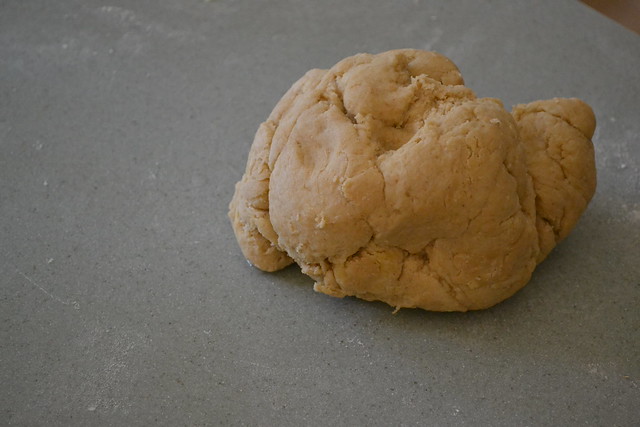
During the mixing process, I added a healthy additional squeeze from the honey bottle. Add a little bread flour and/or water as needed and knead with stand mixer or by hand until a ball forms. Have no fear if it's a heavy, heavy dough. Mine was, and my experience is that most whole wheats are. Don't worry, the end result is worth it!

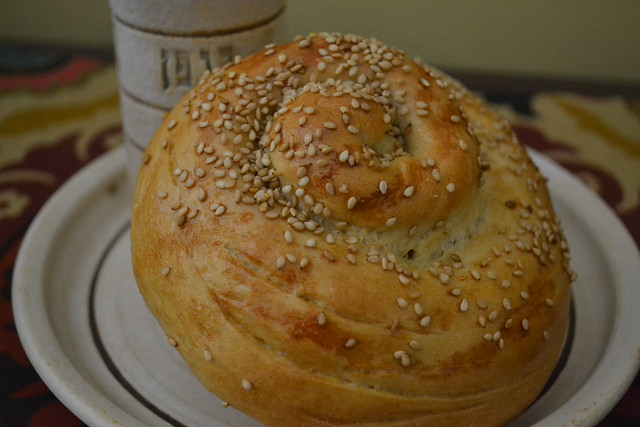
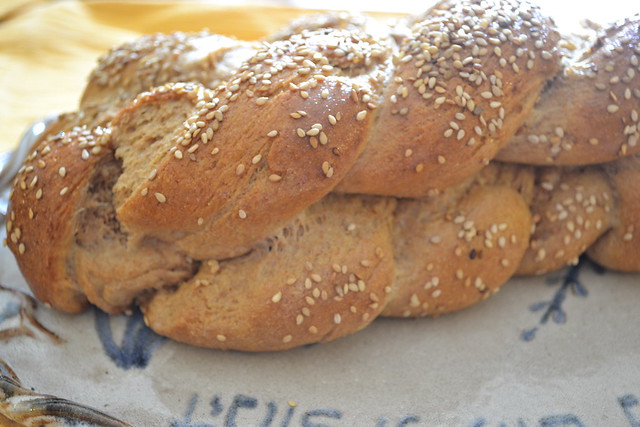
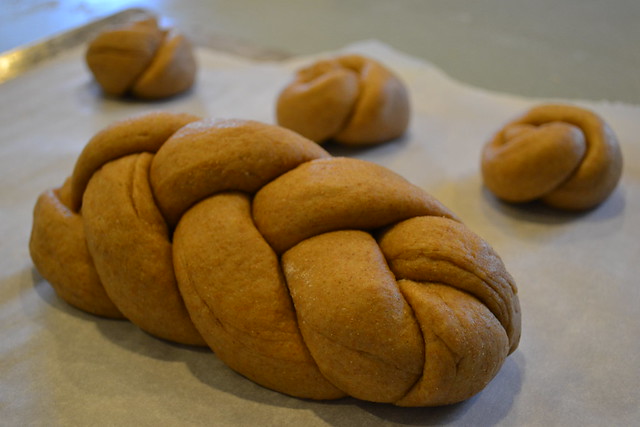
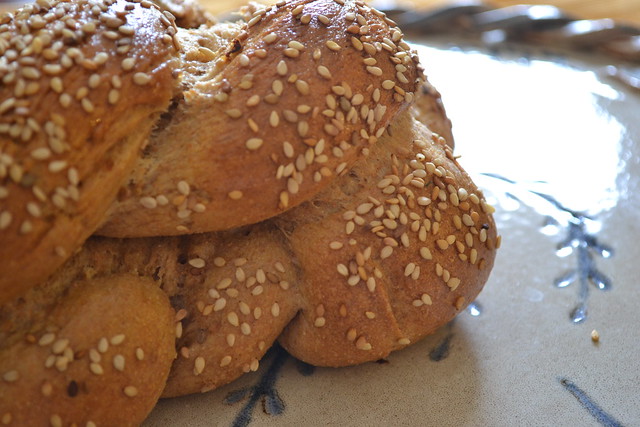
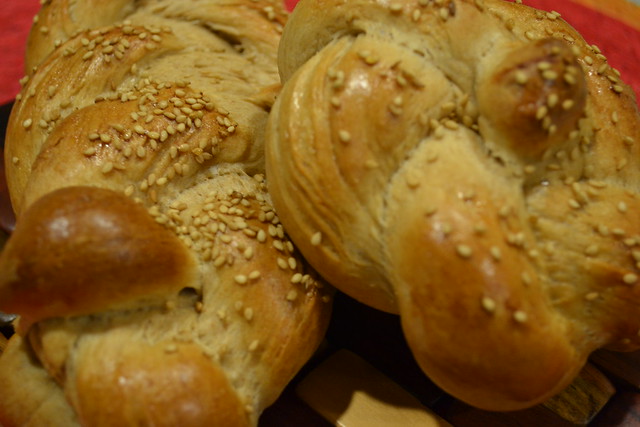
Let dough rest in an oiled bowl (covered) until doubled in bulk, about 1 1/2 hours. You can punch down and let rise again or skip it. I usually don't. Braid as normal. Since this dough isn't very stretchy, I just did a 3-strand braid and some little rolls. Let rest additional 3 minutes. Egg wash and drizzle with honey and your favorite toppings such as sesame or poppy seeds. Bake at 350 for 25-30 minutes.
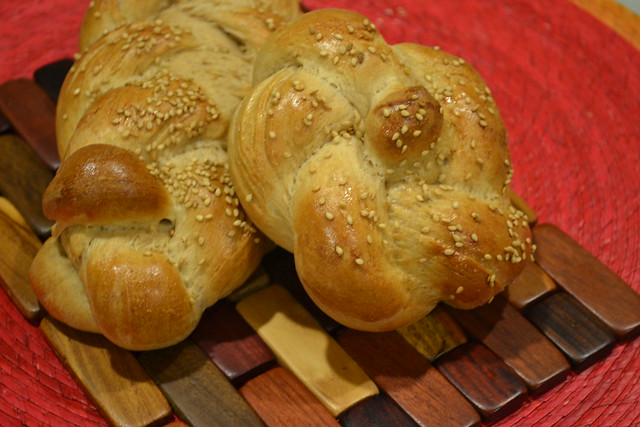
sprouted2
Shabbat Shalom from our bayit to yours!

Wednesday, October 12, 2011

Sukkot 5772: Kamut Challah

I'm having so much fun with my King Arthur Flours, and for Sukkot, I tried making Kamut Flour Challah. King Arthur Flour's website says:
Discover the goodness of ancient grains. This Egyptian relative of wheat, now cultivated in North America, adds fiber, protein, and a slightly sweet taste to all your baking.
I'm not actually 100% sure I can even use Kamut Flour as challah, so please feel free to weigh in.  My research leads me to believe that is a wheat.  The exact origin of Khorasan What/Kamut is not known, but I read a few places that think it might be somewhere in the Fertile Crescent, which seems appropriately Biblical.  I did find this amazing hieroglyphic on Kamut, the name which comes from the hieroglyph for wheat.
Source
According to the website (the grain is patented), KAMUT® khorasan wheat shall:
1. Be the ancient khorasan variety of wheat
2. Be grown only as a certified organic grain
3. Have a protein range of 12 – 18%.
4. Be 99% free of contaminating varieties of modern wheat.
5. Be 98% free of all signs of disease.
6. Contain between 400 and 1000 ppb of selenium
7. Not be used in products in which the name is deceptive or misleading as to the content percentage
8. Not be mixed with modern wheat in pasta
So, here's what I did for my Kamut Challah (yield 3 small or 2 medium round loaves)

kumat3/4 c water
2 1/2 tsp active dry yeast (I actually used fresh yeast, but this is the quantity to use)
1 tbsp honey
1 eggs plus 1 more for egg wash
1/4 c vegetable oil
1 1/2 c bread flour
1 1/2 c kamut flour
1 1/4 tsp salt

Proceed as you would with the Basic Challah. The dough reminded me a lot of Spelt Challah. Dense. Beyond belief. Like polenta. But it did rise quite lovely. I wasn't feel adventurous enough to tackle anything more than a coil with this heavy loaf. But I was still pleased, they were really quite lovely :) I snuck a taste with a small role, and I totally prefer this to both Whole Wheat and Spelt Challah!
kumat2

Hag Sukkot Same'ah from our Bayit Sukkah to yours :)

Friday, May 6, 2011

Spelt Challah

spelt2Today, we tried a regular challah and a spelt challah. The more I read about spelt, the more I'm fascinated by it. It's actually mentioned in the Bible (Exodus 9:30, Isaiah 28:25, and Ezekiel 4:9) and is a very, very ancient grain.

That said, boy I found it really hard to work with! I had read online that since spelt lacks the elasticity of wheat flour (something about the proteins breaking down... I think...?), not to knead it very much and to cut down the water used. I did both of these things, but my dough was almost polenta and certainly not elastic or stretchy at all. SUPER DENSE. Here's what I did.

spelt71/2 c water
2 tsp active dry yeast
1 1/2 tbsp honey
2 eggs
1/4 c vegetable oil
3 c flour
1 1/4 tsp salt

Proof yeast in hot water with honey. Add oil and eggs. Mix in spelt with spatula and knead by hand, adding more spelt if super sticky. I basically just kneaded until combined and then gave it a few good turns. While I usually use my Kitchen Aid, most of what I read said not to, so I kneaded everything by hand.

Let rise LESS TIME than you would regular dough. I let it rise about two hours, until it had gotten larger, but not really doubled yet. This is where mine got weird. While I trust not to let it rise very much, my dough had no elasticity. Braid in your desired style. Let rise an additional 30 minutes. Bake 30-35 minutes (it was longer than wheat dough) at 350.
spelt4
The verdict. We like it. I made a couple rolls so that we could sample it before Shabbat (shhh...). It's definitely a little flakier that regular dough, but we really don't like all whole wheat challah. I think this would be a good substitute. So, I give it an A-. Weird to work with, but it's got a lovely nutty flavor.
spelt6